Sweat-Based Drug Testing vs. Urine Testing: Understanding Detection Windows and Use Cases
February 10, 2026
Drug testing can raise questions.
Parents want to know how to confirm suspected use when a child denies it. Counselors and social workers want tools that are accurate and fair. Courts and programs want results they can trust.
For decades, urine analysis has been the most common answer. It still plays an important role, but it is not the only option.
One alternative many people are less familiar with is sweat-based drug testing using a wearable patch. This article explains how sweat testing works, what it measures, where it fits, and what it can and cannot do.
What Is Sweat-Based Drug Testing?
Sweat-based drug testing uses a small adhesive patch worn on the skin for an extended period of time. While worn, the patch continuously collects drugs and drug metabolites excreted through insensible perspiration.
Insensible perspiration is not visible sweat, like you would expect to see from a workout. It is the constant release of water vapor through the skin that occurs in every living person.
What Are Drug Metabolites?
As drugs circulate through the bloodstream, the body begins breaking them down through normal metabolic processes. During this process, the original substance, often referred to as the parent drug, is chemically transformed into one or more drug metabolites.
These metabolites, along with small amounts of the parent drug, are gradually eliminated from the body. Some are excreted through insensible perspiration and captured by the sweat patch over time.
Drug metabolites are important because they demonstrate actual ingestion and internal processing, not just contact with a substance in the environment. Simply touching or being near a drug does not cause the body to produce metabolites. Metabolites only appear when a drug has entered the body and been metabolized.
By collecting both parent drugs and metabolites continuously during the wear period, sweat-based testing provides a clearer picture of whether drug use occurred, rather than relying on a single moment in time.
Why Metabolites Matter in Sweat Testing
The PharmChek Sweat Patch is designed to collect both parent drugs and their metabolites over the entire wear period. This cumulative collection is what allows sweat testing to distinguish between true drug use and external exposure.
If a sweat patch result is confirmed positive, it reflects that the body absorbed and processed the drug during the monitoring period. This is a key reason sweat patch results are considered reliable and defensible when confirmed using LC-MS/MS, the platinum standard in forensic toxicology.
Because the patch collects continuously, it captures evidence of use whenever it occurs during wear, rather than relying on a single point-in-time sample.
A Passive Collection Method
The sweat patch acts as a passive collector. It does not introduce chemicals into the body, draw fluids, or require any action from the wearer.
Once applied, the patch simply remains in place while the body continues its normal processes and wearers go about their day-to-day activities. Drugs and metabolites are collected gradually and stored in the patch until the patch is removed and sent to the laboratory for analysis.
This passive, continuous collection is what makes sweat-based testing fundamentally different from snapshot testing methods, and it is why metabolites play such a critical role in interpreting results.
What the Sweat Patch Looks Like and How It’s Worn
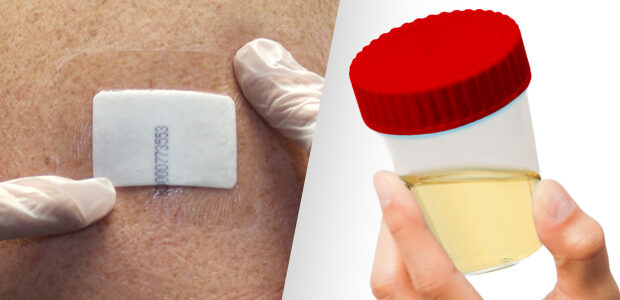
The sweat patch is roughly the size of a large medical bandage. It is most commonly applied to the upper arm, between the shoulder and elbow, using a surgical-grade adhesive film similar to what is used to secure IV lines or post-procedure dressings.
Once applied, the patch can be worn during normal daily activities, including:
- Showering
- Bathing
- Exercising
- Sleeping
Activities that produce extreme or prolonged heat, such as saunas or hot tubs, are generally discouraged.
Most people wear the patch for 7 to 10 days. Some individuals may tolerate shorter or longer wear times depending on skin type, activity level, and environment. A minimum wear time of 24 hours is required for analysis, though longer wear provides a broader detection window.
Continuous Monitoring Versus Snapshot Testing
The most important difference between sweat testing and urine testing is not accuracy—it’s time.
Urine testing captures a snapshot, typically for 1 to 3 days, depending on the substance.
Sweat testing captures a continuous record. Drug use that occurs at any point during the wear period can be detected.
In addition, sweat testing can detect use that occurred up to 24 to 48 hours before the patch was applied. This reflects the time it takes for drugs to move through the body and be excreted through the skin.
Neither approach is inherently better in all situations—they answer different questions:
- Urine testing is well-suited for detecting recent use.
- Sweat testing is well-suited for monitoring ongoing behavior over time.
Many programs use both.
Application, Removal, and Chain of Custody
Sweat patches should only be applied and removed by trained individuals. This is an important distinction. The process includes:
- Cleaning the application site
- Applying the patch correctly
- Documenting placement
- Removing the patch at the end of the wear period
- Sealing and sending it to the laboratory
This trained handling supports chain-of-custody requirements, particularly in court, treatment, and child welfare settings.
Parents cannot simply apply or remove the patch at home, but they can access it through clinics, counselors, or laboratories authorized to administer the test.
Can the Sweat Patch Be Tampered With?
No drug test is immune to attempted manipulation.
Urine testing has well-documented vulnerabilities, including dilution, substitution, and adulteration. Best practices, such as observed collections, exist specifically to address those risks.
Sweat patches approach the problem differently.
The adhesive film is tamper-evident. If the patch is peeled back, altered, covered, or removed, it shows visible signs that are nearly impossible for a trained individual to miss. Added materials, such as tape or bandages, are also clear indicators of interference.
In most programs, a tampered patch is treated as a presumptive positive or violation, similar to how adulterated urine samples are handled.
Do Body Hair or Skin Types Affect the Sweat Patch?
Hair does not prevent sweat testing.
The upper arm is preferred, but if that location is too hairy or contains pre-existing rashes or abrasions, the sweat patch may be applied to other locations, such as the lower back or midriff. Shaving is discouraged, as regrowth can interfere with the adhesive seal.
Skin type, activity level, and environment all influence how long a patch can be worn comfortably, which is why wear time varies from person to person.
How Are Results Analyzed?
Once removed, the patch is sent to a laboratory for analysis.
The testing process includes two steps:
- Screening
- Confirmation
Any presumptive positive result is automatically confirmed using LC-MS/MS, the platinum standard in forensic toxicology.
LC-MS/MS identifies drugs based on their molecular structure. Only the specific drug and its metabolites will confirm positive.
This is the same confirmatory technology used across forensic toxicology and court-admissible testing.
False Positives, Medications, and Passive Exposure
False positives are a common concern with any drug test.
Screening tests alone can sometimes be misleading, which is why confirmation matters.
With sweat testing:
- Every presumptive positive is confirmed by LC-MS/MS
- Drugs are identified by unique molecular signatures
- Parent drugs and metabolites are evaluated together
This allows laboratories to distinguish between:
- Amphetamines from prescription medications
- Illicit methamphetamine use
- Environmental contact versus ingestion
Passive exposure, such as being near drug smoke or touching contaminated surfaces, does not produce the same metabolite patterns as ingestion.
Environmental contact alone does not hold up under confirmation testing.
Turnaround Time for Results
Turnaround times vary by shipping method and laboratory workload.
Typical timelines once the patch reaches the lab:
- Negative results: 24 to 48 hours
- Confirmed positives: 48 to 72 hours
Results are delivered electronically through secure reporting systems.
Who Uses Sweat-Based Drug Testing?
Sweat-based drug testing is used in a range of structured monitoring environments where ongoing accountability matters more than point-in-time screening.
Common use cases include:
- Drug and treatment courts
- Probation and community corrections
- Child protection and family services
- Treatment and recovery programs
In addition to these settings, sweat-based testing is also used in non-DOT workplace monitoring programs.
Sweat Testing in the Workplace
Sweat-based drug testing is not used for pre-employment screening, random testing, or DOT-regulated workplace programs. It is not a substitute for federally mandated urine or oral fluid testing.
Instead, some employers use sweat testing in post-incident, recovery-focused, or agreement-based workplace scenarios, such as:
- Return-to-work or last-chance agreements following a substance-related policy violation
- Employer-sponsored recovery or compliance programs
- Ongoing monitoring for safety-sensitive roles that are not governed by DOT regulations
In these situations, the sweat patch provides continuous monitoring over several days, allowing employers and third-party administrators to document abstinence over time rather than relying on repeated, observed collections. Testing is typically administered and managed by an external provider, not the employer directly.
When used appropriately, sweat-based testing supports accountability while reducing workplace disruption, minimizing repeated testing appointments, and providing confirmed results using LC-MS/MS.
Sweat testing in the workplace is best understood as a monitoring tool, not a screening tool. It is designed to support compliance and recovery after an issue has already been identified, not to determine employment eligibility.
Key Takeaways
- Sweat-based drug testing uses a wearable patch to collect drugs and drug metabolites through insensible perspiration over several days.
- Drug metabolites are critical because they confirm actual ingestion and internal processing, not environmental contact or passive exposure.
- Sweat testing provides continuous monitoring during the wear period, while urine testing captures only a short snapshot of recent use.
- When confirmed using LC-MS/MS, the platinum standard in forensic toxicology, sweat patch results are accurate, reliable, and legally defensible.
- Sweat patches are tamper-evident and not affected by dilution or excessive fluid consumption, unlike urine testing.
- Sweat-based testing is best suited for courts, treatment programs, child protection, and non-DOT workplace monitoring where ongoing accountability is needed.
- No single testing method fits every situation. Many programs use sweat, urine, oral fluid, and hair testing together as part of a comprehensive monitoring strategy.
Where Sweat Testing Fits in the Bigger Picture
No single testing method answers every need.
Urine testing remains widely used, well understood, and effective when properly administered and confirmed.
Oral fluid testing offers very short detection windows for recent use.
Hair testing provides long-term historical patterns.
Sweat testing fills a different gap—it monitors behavior going forward.
Key takeaway: The best programs have a stocked toolbox, with different tools for different situations.
Choosing the Right Drug Testing Method
Drug testing works best when it is accurate, fair, and understood by everyone involved.
Sweat-based testing is not a new technology. It has been used for decades and continues to serve as one option among many.
For those curious about alternatives to urine testing, the sweat patch offers a different way to look at substance use. Not as a moment in time, but as a continuous record.
Sometimes, it really is worth thinking “outside the cup.”